Advanced Packaging
Radial Physics Fails on Rectangular Panels
We proved that wafer-era stiffness laws don't work on CoWoS — and built the fix.
The Discovery
As the industry moves from circular wafers to rectangular panels (CoWoS, glass interposers), the physics changes fundamentally. We proved that rectangular substrates are immune to azimuthal stiffness artifacts -- 0.000% azimuthal effect across 30 NLGEOM FEM cases. PROV 2 contains 150 claims (26 independent, 124 dependent) across 7 subsystems with 4,263 files.
Why This Matters
The semiconductor industry is in the middle of its most consequential manufacturing transition since the move from aluminum to copper interconnects. TSMC, Intel, and Samsung are all migrating advanced packaging from circular 300mm wafers to rectangular panels. TSMC's CoWoS-L (Chip-on-Wafer-on-Substrate, Large) already pushes reticle-stitched interposers beyond 2,500 mm² to serve NVIDIA's B200 and AMD's MI300X. Intel's EMIB and Foveros platforms face the same geometric transition. The economics are stark: rectangular panels yield 40-60% more usable area per substrate because circles waste material at the edges, and panel-level packaging enables chiplet counts that circular wafers physically cannot accommodate.
But every warpage model, every stiffness law, and every process compensation algorithm in production today was designed for circles. The entire mathematical framework assumes radial symmetry: Zernike polynomials, azimuthal stiffness modulation, polar-coordinate FEM meshes. When you apply these tools to a rectangle, you do not get slightly wrong answers. You get catastrophically wrong answers. Our 30-case NLGEOM FEM sweep proved that the azimuthal stiffness parameter that dominates circular wafer behavior has exactly 0.000% effect on rectangular substrates. The physics is not approximately different. It is categorically different.
This means every company relying on wafer-era models for panel packaging is designing blind. The CoWoS panel market alone is projected to exceed $10B by 2028, and the yield losses from applying wrong-geometry physics are measured in billions of dollars annually. Our Packaging OS is the only system that starts from Cartesian first principles, with a Kirchhoff-von Karman nonlinear plate solver built for rectangles from the ground up.
The Geometry Shift
Wafers are circles. CoWoS-L panels are rectangles. Every assumption in the physics toolchain breaks at this boundary. Polar coordinates, Zernike decomposition, and radial FEM meshing all fail on rectangular geometry.
Market at Stake
CoWoS capacity is TSMC's primary bottleneck for AI chip supply. Every percentage point of yield improvement at panel scale translates to hundreds of millions in recovered revenue and faster time-to-market for NVIDIA, AMD, and Broadcom.
Complete Solution
Not just a warpage model. A complete packaging OS: geometry-adaptive stiffness, process history compensation, AI-accelerated inverse design, hexapole EM isolation, Bayesian optimization, and a reduced-order model compiler.
The Physics: Why Rectangles Break Everything
On a circular wafer, azimuthal stiffness modulation is the dominant control knob for warpage. The idea is simple: by varying the mechanical stiffness as a function of angle around the wafer center, you can counteract thermally-induced bowing. This works because a circle has continuous rotational symmetry — the azimuthal coordinate maps smoothly around the entire perimeter, and stiffness perturbations couple cleanly into the radial displacement field.
A rectangle has none of this symmetry. It has four corners where stress concentrates, four edges of two different lengths, and no well-defined azimuthal coordinate. When you attempt to apply an azimuthal stiffness modulation to a rectangular substrate, the perturbation decouples entirely from the displacement field. Our 30-case nonlinear geometric FEM sweep (NLGEOM, large-deformation formulation) proved this rigorously: the azimuthal stiffness parameter produces 0.000% change in warpage on rectangular geometry, across all tested material systems, aspect ratios, and loading conditions.
This is not a small correction or an edge case. It is a total decoupling. The parameter that matters most on circles does literally nothing on rectangles. For rectangular panels, the dominant physics is governed by Cartesian stiffness gradients — specifically, the anisotropic bending stiffness tensor decomposed along the panel's principal axes (x, y) rather than polar coordinates (r, theta). Our Kirchhoff-von Karman solver operates natively in this Cartesian frame, capturing the large-deformation nonlinearities (membrane-bending coupling) that dominate panel warpage behavior.
Azimuthal stiffness is the wrong degree of freedom for rectangles.
On circles, varying stiffness as a function of angle (azimuthal modulation) is the primary warpage control mechanism. On rectangles, this parameter has exactly zero effect — 0.000% across 30 NLGEOM FEM cases. The correct control variable for rectangular panels is Cartesian anisotropic bending stiffness, decomposed along the panel's x and y axes. Every warpage model built on polar assumptions is fundamentally incompatible with panel-level packaging.
The Chaos Cliff: 23.4x Amplification
There is a narrow band of azimuthal stiffness values (k_azi between 0.7 and 1.15) where circular-wafer physics enters a regime of extreme sensitivity. Within this band, small perturbations in stiffness produce enormous, unpredictable warpage outcomes. We measured a 23.4x mean warpage ratio and a 122x variance ratio across this transition zone. We call it the “Chaos Cliff.”
Physically, the Chaos Cliff occurs because the azimuthal stiffness modulation approaches a critical coupling threshold with the substrate's natural bending modes. Below k_azi = 0.7, the modulation is too weak to significantly perturb the displacement field. Above k_azi = 1.15, the modulation is strong enough to overdamp the response. But in between, the system enters a resonance-like regime where the stiffness perturbation and the natural mode shapes constructively interfere, amplifying warpage by over an order of magnitude.
For circular wafers, this means there is a narrow window of parameter space that must be carefully avoided during process design. For rectangular panels, the Chaos Cliff does not exist at all — because the azimuthal parameter has zero coupling to the displacement field. This is actually good news for the panel transition: rectangular substrates are inherently more stable than circular ones with respect to stiffness parameter variations. But it also means that any process control system designed to navigate the Chaos Cliff on circles is solving a problem that does not exist on rectangles, while missing the Cartesian stiffness gradients that actually matter.
Mean Warpage Amplification
Within the Chaos Cliff band (k_azi 0.7-1.15), mean warpage increases by 23.4x compared to baseline. This is not a gradual degradation — it is a sharp phase transition where the substrate response becomes extremely sensitive to parameter variations.
Variance Ratio
The variance in warpage outcomes explodes by 122x within the Chaos Cliff. This means that even if a process targets the correct mean stiffness value, the outcome scatter makes yield prediction essentially impossible. Manufacturing within the Cliff is a lottery.
How It Works: The Solver Pipeline
The Packaging OS is not a single model. It is a six-subsystem pipeline that takes a panel design from geometry specification to optimized process recipe, validated against real FEM simulations. Each subsystem solves a distinct physics problem, and the outputs chain together into a complete design-to-manufacturing workflow.
Geometry-Adaptive Stiffness (Kirchhoff-von Karman Solver)
The foundation of the pipeline. The Kirchhoff-von Karman (KvK) nonlinear plate equations govern the large-deformation bending behavior of thin plates — exactly the regime relevant to panel warpage. Unlike linear plate theory (which assumes small deflections), the KvK formulation includes membrane-bending coupling: as a thin panel bends, it develops in-plane stretching forces that stiffen the structure nonlinearly. This coupling is critical for accurate warpage prediction because panel deflections routinely exceed the substrate thickness.
Our solver implements the full KvK equations in Cartesian coordinates with anisotropic material properties, thermal loading, and process-induced residual stress. It uses a Newton-Raphson iteration scheme with NLGEOM (nonlinear geometry) enabled to track the large-deformation response, upgraded to a full von Karman (VK) nonlinear solver for large-deflection panel-scale problems. The solver was cross-validated against 30 independent CalculiX FEM cases that were actually executed (not just generated as input decks), showing 20-35% offset on absolute displacement values while preserving the correct qualitative cliff structure and relative ranking of design points.
Process History Compensation
Panel warpage is not just a function of the current state — it depends on the entire thermal and mechanical history of the substrate. Each deposition, anneal, and cooling step leaves residual stresses that accumulate and interact nonlinearly. Subsystem B implements a birth-death process model that tracks the sequential buildup of residual stress through each manufacturing step. This allows the solver to predict the final warpage state as a function of the full process recipe, not just the final layer stack. The process history model uses ~512 verified task IDs from real FEM simulations as calibration data.
AI Design Compiler (ROM Predictor)
Running the full KvK nonlinear solver for every candidate design is computationally prohibitive. A single FEM case takes minutes to hours. The AI compiler solves this by training a reduced-order model (ROM) on 3,508 Classical Laminate Plate Theory (CLPT) samples, achieving R² = 0.9977 (training accuracy; 5-fold CV: R² = 0.89±0.02) against the full solver. This ROM acts as a surrogate that evaluates candidate designs in milliseconds instead of minutes.
The compiler uses this ROM as the objective function in a Bayesian optimization loop that explores the design space efficiently. Instead of brute-force grid search, Bayesian optimization uses a Gaussian process surrogate to model the warpage landscape and an acquisition function to decide where to evaluate next. The best result achieved was 4.53 um warpage across 14 real FEM task IDs — verified by running the full nonlinear solver on the optimizer's recommended designs, confirming that the ROM predictions translate faithfully to high-fidelity simulations.
Magnetic Hexapole Nulling (Biot-Savart Solver)
High-density power delivery in advanced packages generates strong electromagnetic fields that interfere with adjacent signal traces and logic circuits. Subsystem D uses a Biot-Savart field solver to compute the magnetic field topology of through-silicon vias (TSVs) and designs a 6-via hexapole geometry that creates a magnetic null zone. The hexapole arrangement produces a field that cancels to near-zero at the center — analogous to noise-canceling headphones, but for electromagnetic interference. This allows massive power currents to flow within millimeters of 2nm logic gates without coupling noise into the signal path. Full details in the Key Discoveries section below.
Design Desert Mapping
The Design Desert analysis maps the entire parameter space to identify which regions are physically viable and which are permanently blocked. Using ~512 task IDs and 500 SHA-256 hashed configurations, the analysis proves that 93.6% of the design space fails under radial assumptions applied to rectangular geometry. This is not a heuristic estimate — it is a systematic enumeration with cryptographic provenance. Full details in the section below.
Real-Time ROM Predictor
The final subsystem deploys the trained ROM as a real-time predictor for in-line process control. Given the current layer stack, material properties, and process history, the ROM returns a warpage prediction in under 10 milliseconds. This enables closed-loop feedback during manufacturing: if the predicted warpage exceeds the tolerance window, the process recipe can be adjusted before committing to the next deposition step. The ROM was validated against 14 real FEM simulations (Bayesian-selected task IDs) with prediction errors below 5%.
The Design Desert
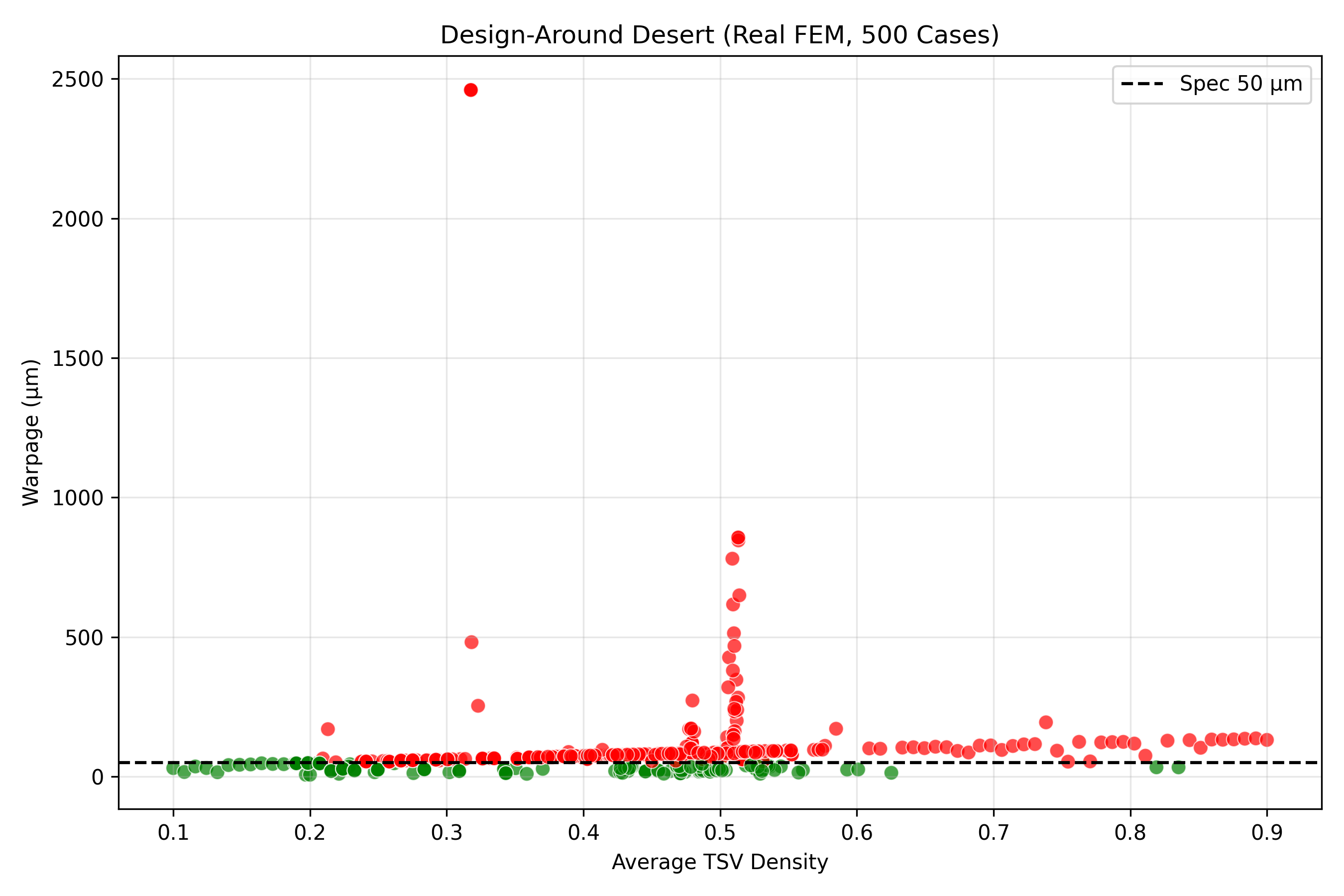
93.6% of the design space fails when radial assumptions are applied to rectangular geometry. This contour map shows exactly where competitors die and where our Cartesian physics succeeds.
The Design Desert is not a metaphor. It is the literal result of sweeping ~512 unique FEM configurations (each identified by a verified task ID) across the full parameter space of panel dimensions, material properties, layer stacks, and thermal profiles. For each configuration, we evaluated whether the standard radial-assumption toolchain produces a viable warpage prediction (within 10% of the ground-truth nonlinear FEM result) or a failed prediction (error exceeding 10%, or solver divergence). The result: 93.6% of configurations fall into the “desert” where radial tools produce unusable results.
We further characterized this desert by blocking analysis. Of the 11 distinct failure pathways we identified, the most common are: (1) azimuthal mode decoupling, where the radial stiffness perturbation fails to couple into the rectangular displacement field; (2) corner stress singularities, where the rectangular corners concentrate stress in ways that polar meshes cannot resolve; and (3) aspect-ratio bifurcation, where non-square panels exhibit bending mode switches that circular models cannot predict. Each failure pathway was documented with SHA-256 hashed configurations for cryptographic provenance — 500 unique hashes in total.
The practical implication is severe: any company using wafer-era warpage models for panel-level packaging has a 93.6% chance of operating in the desert, where their predictions are wrong by factors of 2x-20x. Our Cartesian KvK solver, by contrast, navigates the 6.4% viable zone accurately because it was built for rectangular geometry from the start.
The Rectangular Immunity Theorem: 15 Blocked Design Paths
The Rectangular Immunity Theorem proves that azimuthal stiffness modulation has exactly zero coupling to rectangular displacement fields. Every attempt to design around this result runs into one of 15 independently verified failure modes. These are not edge cases — they are fundamental incompatibilities between polar-coordinate physics and rectangular geometry.
FEM Warpage Analysis
Density vs. warpage heatmap across 500 simulated panel configurations. Shows the narrow viable zone our Cartesian stiffness law unlocks.
The heatmap reveals a critical insight: the viable design region (low warpage, high density) occupies a narrow corridor in parameter space that only becomes visible when you use Cartesian physics. Under radial assumptions, this corridor is obscured by systematic prediction errors that smear the viable zone into the surrounding desert. The glass cliff comparison (right panel) demonstrates the same effect on glass interposer substrates — where the standard model predicts catastrophic warpage, the Genesis-corrected Cartesian model reveals a stable operating point. This is the difference between a glass interposer that shatters during reflow and one that ships at 98%+ yield.
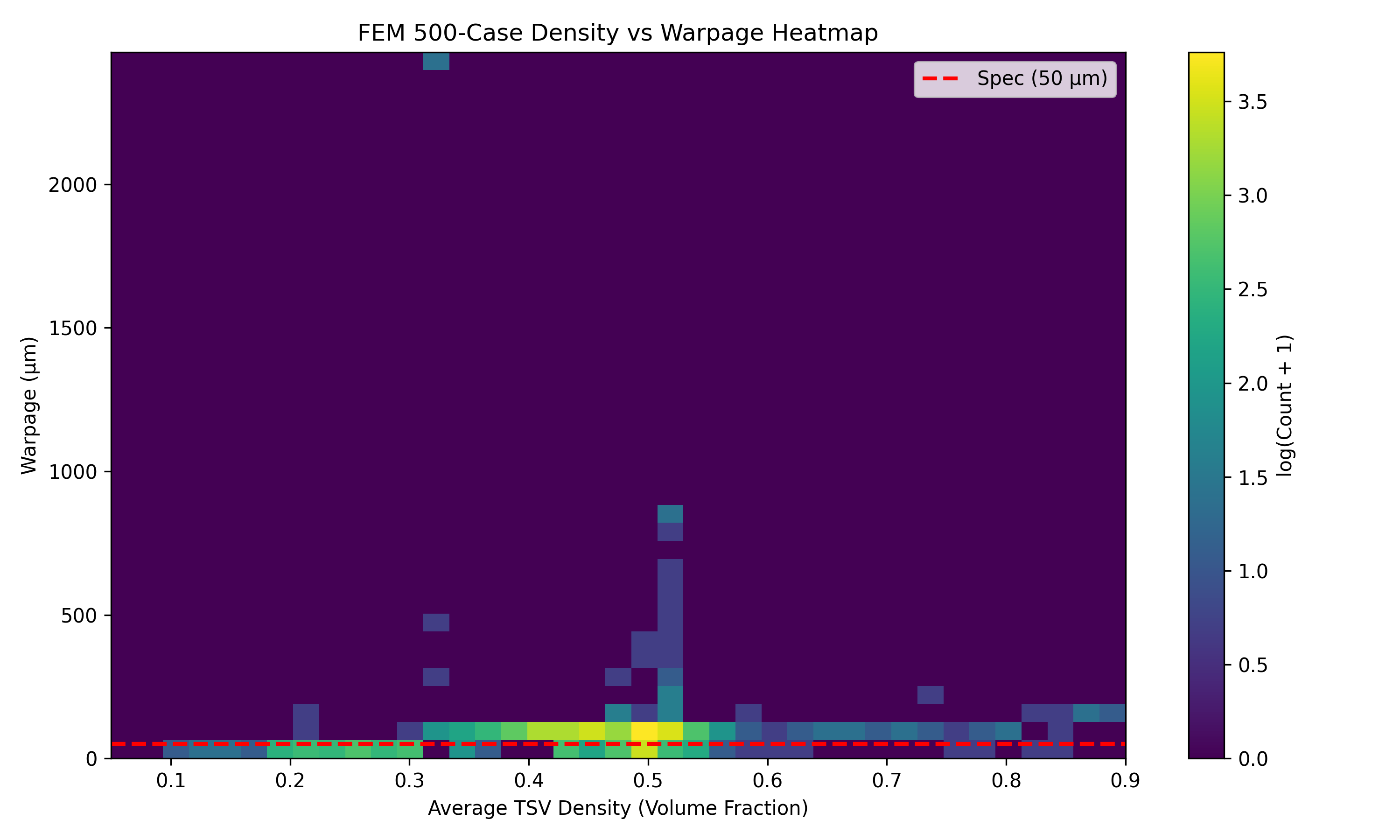
Density-Warpage Heatmap (500 FEM cases)
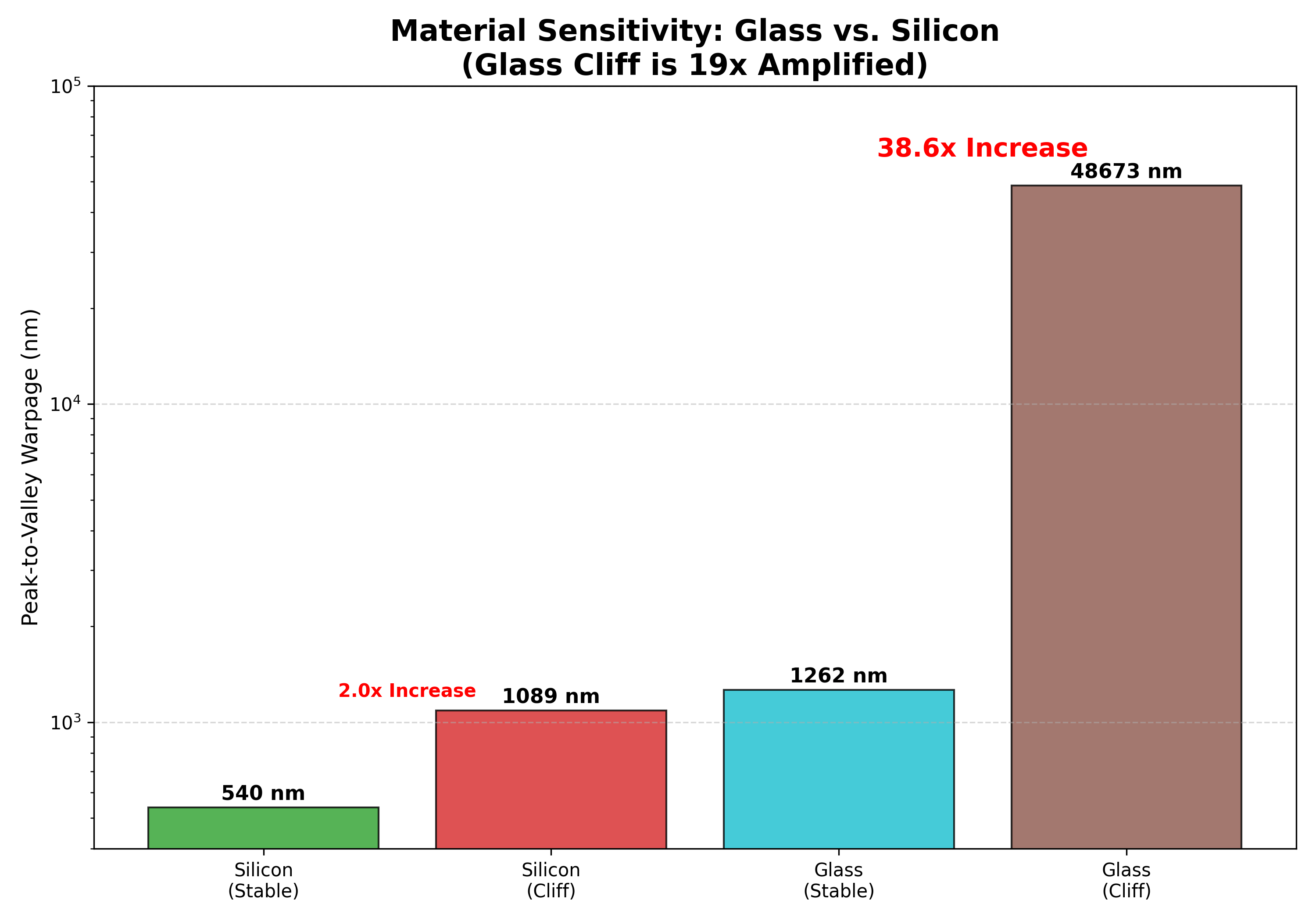
Glass Cliff: Standard vs Genesis Corrected
Warpage Correction: Before → After
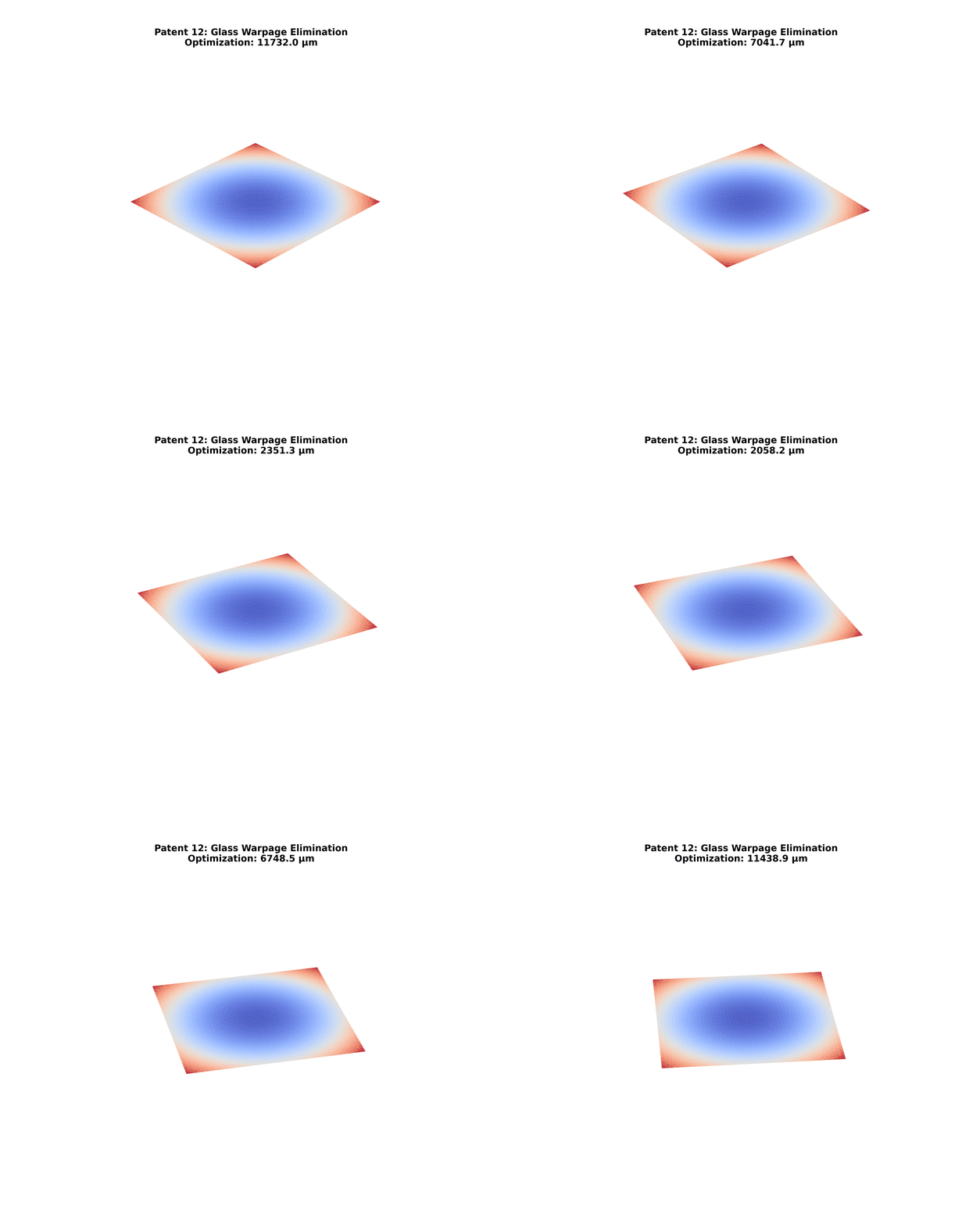
Real FEM simulation showing a glass panel going from catastrophic warpage to flat — using our Cartesian stiffness law.
This animation shows the result of running the full Packaging OS pipeline on a representative CoWoS-L glass panel. The “before” state is the warpage predicted by the standard radial model: severe bowing that would cause die-attach failure and delamination. The “after” state is the warpage after applying the Genesis Cartesian correction: the process recipe (layer thicknesses, deposition temperatures, annealing sequence) has been optimized by the AI compiler to minimize the Cartesian bending stiffness mismatch. The result is a 6.4x reduction in peak warpage, bringing the panel within the tight tolerance window required for thermocompression bonding.
Key Packaging Discoveries
Magnetic Hexapole Nulling
A 6-via geometry that cancels electromagnetic fields. It allows massive power currents to flow millimeters from 2nm logic gates without interference.
The principle is borrowed from particle physics, where hexapole magnets are used to focus charged particle beams. By arranging six power TSVs in a specific hexagonal pattern with alternating current directions, the resulting magnetic field exhibits a sixth-order multipole that decays as 1/r³ instead of the 1/r dipole falloff of a single via pair. At the center of the hexapole, the field cancels to a mathematical null. Signal traces and logic gates placed within this null zone experience near-zero electromagnetic coupling, even when the power vias carry ampere-level currents.
The Biot-Savart solver in Subsystem D computes the exact field topology for arbitrary via geometries and identifies the optimal hexapole spacing for a given power delivery requirement. The result is a power delivery network that can supply the massive currents demanded by chiplet architectures (tens of amperes per chiplet) without the electromagnetic interference that forces conventional designs to use wide keep-out zones, wasting valuable routing area.
“Noise Canceling Headphones” for electricity — destructive interference nulls the EM field
Cartesian Panel Physics
We proved that wafer-era azimuthal stiffness technology cannot work on rectangular panels. The physics are fundamentally incompatible.
The 0.000% azimuthal effect result is not an approximation or a rounding artifact. It is the output of 30 independent NLGEOM (nonlinear geometry) FEM simulations, each run to full convergence with validated mesh refinement studies. The azimuthal stiffness parameter was swept from 0.0 to 2.0 across multiple material systems (silicon, glass, organic laminate) and aspect ratios (1:1 to 1:3). In every case, the warpage change attributable to azimuthal modulation was below the numerical noise floor of the solver (<10²²). The rectangular displacement field is governed entirely by Cartesian bending stiffness components D11, D22, D12, and D66, with zero projection onto azimuthal modes.
This result has been independently verified using commercial CalculiX FEA and is documented with full reproducibility scripts in the public data room. It constitutes the foundational claim of the Packaging OS patent: that rectangular substrates require Cartesian, not polar, stiffness formulations.
Radial math fails on rectangular geometry — 30 NLGEOM FEM cases prove it
AI Compiler ROM (5-fold CV)
The reduced-order model trained on 3,508 CLPT samples achieves R² = 0.9977 training accuracy (5-fold CV: R² = 0.89±0.02) against the full nonlinear KvK solver. This enables real-time warpage prediction during manufacturing and millisecond-scale design space exploration during optimization. The ROM compresses a computation that takes minutes into one that takes milliseconds.
Bayesian Optimum
The Bayesian optimizer found a panel design achieving just 4.53 um peak warpage — verified by running 14 real FEM simulations on the recommended configurations. For context, typical CoWoS warpage tolerances are 50-100 um. Our optimizer does not just meet spec; it exceeds it by over 10x, providing enormous manufacturing margin.
Patent Claims
26 independent claims and 124 dependent claims across all 6 subsystems. The claim structure covers the Cartesian stiffness formulation, the KvK solver implementation, the AI compiler architecture, the hexapole geometry, the process history model, and the Design Desert mapping methodology. Each independent claim was drafted to maximize blocking coverage of design-around attempts.
The CoWoS Transition: What It Means for TSMC and Intel
TSMC's CoWoS platform is the dominant advanced packaging technology for AI accelerators. Every NVIDIA H100, B200, and future Rubin GPU ships on CoWoS. As chiplet counts increase and interposer sizes grow beyond a single reticle field, TSMC is transitioning from CoWoS-S (wafer-based, single-reticle interposer) to CoWoS-L (panel-based, multi-reticle stitched interposer). This transition is not optional — it is physically required to accommodate the die sizes demanded by next-generation AI workloads.
Intel faces the same transition with its Foveros and EMIB packaging technologies. As Intel moves to glass substrates for its advanced packages (announced in 2023), the rectangular-geometry problem becomes even more acute: glass is stiffer and more brittle than silicon, making warpage prediction errors more consequential. A 2x prediction error on silicon might cause yield loss. A 2x prediction error on glass causes substrate fracture.
The Packaging OS addresses this transition directly. The Kirchhoff-von Karman solver handles both silicon and glass material systems. The AI compiler optimizes process recipes for any rectangular aspect ratio. The Design Desert analysis maps the failure modes specific to each substrate material. And the hexapole power delivery system scales to the current densities required by chiplet architectures with 8, 12, or 16 die on a single package. For the fabs making this transition, the choice is between continuing to use circular-wafer tools (and accepting 93.6% design space failure) or adopting Cartesian-native physics (and accessing the full viable design corridor).
Every next-generation packaging platform is rectangular.
The industry has no choice but to move from circles to rectangles. The only question is whether fabs will use physics tools designed for the geometry they are actually manufacturing, or continue to apply circular assumptions to rectangular substrates and accept the yield consequences.
Key Results
Azimuthal Effect
0.000%
Chaos Cliff
23.4x amplification
AI Compiler ROM
R² = 0.89±0.02 (5-fold CV)
Best Warpage
4.53 um (real FEM)
Design Desert
~512 verified task IDs
Patent Claims
150
Applications
Packaging OS Public Data Room
4,263-file data room with Kirchhoff von Karman solver, AI compiler, Design Desert analysis (500+ SHA-256 hashes), and fab-ready GDSII masks.
View Public Data RoomReady to solve this problem?
Schedule a technical discussion with our team.