Platform
One Physics Law to Rule Them All
A unified optimization principle that works across structural, thermal, and optical domains.
The Discovery
We discovered that optimal material distribution follows the same mathematical principle whether you're designing a wafer chuck, a cooling system, or an optical substrate. This 'Universal K Law' unifies physics domains that were previously siloed. The Genesis Engine (v3.0.0) implements this principle across 104 solvers spanning 9 patent data rooms with 900+ total claims.
Why Multi-Physics Coupling Matters
Real engineering systems do not obey one set of equations at a time. A semiconductor chip under load generates heat (thermal), which causes the die to expand and warp (structural), which shifts the waveguide geometry and changes optical mode confinement (electromagnetic), which alters signal integrity and power dissipation, which feeds back into heat generation. These coupled feedback loops are the rule in advanced hardware, not the exception. Any simulation that treats these domains in isolation produces answers that diverge from reality the moment operating conditions become non-trivial.
Multi-physics simulation means solving the governing equations of two or more physical domains simultaneously, passing field data between solvers at every timestep or iteration so that each domain sees the effect of all the others. Thermal fields deform structures. Structural deformations shift electromagnetic resonances. Electromagnetic losses generate heat. Electrochemical reactions change material properties. Fluid flow redistributes thermal energy. Phase transformations alter mechanical stiffness. Every link in that chain matters when you are designing at the limits of what physics allows.
The Genesis Platform was built from the ground up to make these couplings first-class citizens. Instead of running a thermal solver, exporting a temperature field to a file, manually importing it into a structural solver, and hoping the boundary conditions survive the translation, Genesis passes field data through a generic coupler that preserves mesh topology, enforces conservation laws at domain interfaces, and handles the time-stepping synchronization automatically. The result is that an engineer can set up an LBM fluid simulation, couple it to an FEM structural solver, and get a fully converged thermal-structural solution in a single API call.
The Coupling Chain: Every Domain Talks to Every Other
Thermal expansion warps geometry, induces residual stress
Deformed waveguides shift mode confinement and resonance
Ohmic and dielectric losses generate localized heat
Convective transport redistributes thermal energy across surfaces
Lithium plating triggers dendrite nucleation and growth
Phase transformations change local stiffness and fracture toughness
104 Solvers, One Unified Coupler
The Genesis Engine ships 104 physics solvers spanning six major families: Lattice Boltzmann Methods (LBM) for computational fluid dynamics, Finite Element Methods (FEM) for structural mechanics, Finite-Difference Time-Domain (FDTD) for electromagnetics, Molecular Dynamics (MD) for atomistic simulation, Phase-Field methods for microstructure evolution, and Chemistry solvers for reaction kinetics and rare-earth separation. Each family contains multiple variants tuned for different regimes: LBM includes D2Q9, D3Q19, multi-relaxation-time (MRT), and Large Eddy Simulation (LES) turbulence models; FEM covers 2D plane stress, 3D solid mechanics, Cook membrane benchmarks, and gmsh-integrated meshing; FDTD spans 2D and 3D with perfectly matched layer (PML) absorbing boundaries.
What makes this collection a platform rather than a toolbox is the generic coupler in genesis/multiphysics/coupler.py. This module defines a universal interface for passing field data between any two solvers: temperature fields from thermal to structural, displacement fields from structural to electromagnetic, velocity fields from CFD to thermal. The coupler handles mesh interpolation when source and target grids differ, enforces energy conservation at domain boundaries, and manages the staggered time-stepping required when solvers operate at different characteristic timescales. Five specialized pipelines are built on top of this generic coupler:
Thermal-Structural
Temperature field drives thermal expansion in FEM. Computes stress, strain, and warpage from non-uniform heating. Used in PROV 1 and PROV 2 for wafer and substrate analysis.
LBM-Thermal-Structural
Full three-way coupling: LBM computes fluid flow and convective heat transfer, thermal solver resolves conjugate conduction, FEM predicts structural deformation. The pipeline used for self-cooling battery and chip thermal management.
FDTD Optical Lattice
Electromagnetic wave propagation through periodic structures. Computes transmission, reflection, and mode confinement in photonic crystals and glass waveguides. Feeds PROV 4 and PROV 8 isolation analysis.
Marangoni Zero-G
Coupled surface-tension-driven flow in microgravity. Combines VOF interface tracking with solutal Marangoni convection for space-based thermal management. Bond number verification ensures stability at Bo < 0.1.
Generic Coupler
The base class that all pipelines inherit from. Defines the field transfer protocol, mesh interpolation interface, conservation checks, and time-step synchronization logic. Any new solver pair can be coupled by implementing two methods.
Hardware Acceleration: JAX and PyTorch backends
Performance-critical solvers ship with GPU-accelerated variants: JAX LBM 2D/3D for fluid dynamics, PyTorch LBM 3D for thermal-fluid coupling, and PyTorch FDTD 3D for electromagnetic simulation. These run on NVIDIA A100/H100/B200 GPUs and deliver 10-100x speedups over CPU for production-scale meshes, enabling parametric sweeps across thousands of design points in hours rather than weeks.
Inside the LBM-FEM Thermal-Structural Pipeline
The LBM-to-FEM thermal-structural pipeline is the workhorse coupling in Genesis and illustrates why multi-physics coupling is so much more than file-based data transfer. The pipeline begins with a Lattice Boltzmann CFD simulation that resolves fluid flow around a heated geometry: a chip die on a substrate, a cooling channel in a battery pack, a waveguide structure carrying high-power optical signals. The LBM solver (D2Q9 or D3Q19, depending on dimensionality) computes the velocity and temperature fields at every lattice node, naturally capturing convective heat transfer without requiring explicit convection correlations.
Once the LBM solver converges, the coupler extracts the temperature field at the solid-fluid interface and interpolates it onto the FEM mesh. This is not a simple copy operation. The LBM grid is typically a regular Cartesian lattice while the FEM mesh may be unstructured with triangular or tetrahedral elements that conform to complex geometry. The coupler performs conservative interpolation: the total heat flux across the interface is preserved to machine precision, so that energy is neither created nor destroyed in the handoff between solvers. The FEM solver then computes the thermal strain field using the temperature-dependent coefficient of thermal expansion, solves the elasticity equations for displacement and stress, and returns the deformed geometry.
In a fully iterative coupling, the deformed geometry feeds back into the LBM solver: the fluid domain has changed shape, the channel height has shifted, the flow resistance is different. The pipeline iterates until both the thermal and structural fields converge to a self-consistent state. This is the kind of coupling that file-based workflows simply cannot do. By the time you have manually exported, re-meshed, re-imported, and re-solved, the iterative convergence that captures the real physics is impractical. The Genesis pipeline handles it in a single API call: POST /v1/platform/pipeline/lbm-fem.
D2Q9/D3Q19 fluid flow + convective heat transfer
Temperature at solid-fluid interface
Conservative mapping to FEM mesh
Thermal strain, displacement, von Mises stress
Deformed geometry feeds back to LBM
The Design Desert
Without the Universal K Law, 93% of the design space leads to failure. This map shows exactly where physics allows viable solutions — and where competitors die.
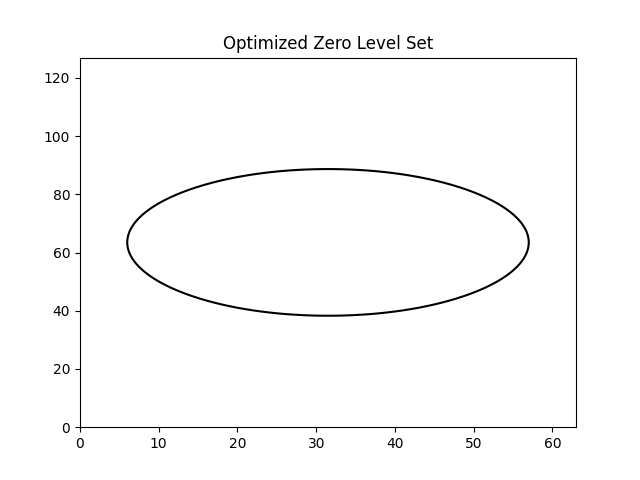
AI-Driven Design Evolution
The Genesis Engine evolves optimal geometries from random noise using reinforcement learning guided by real physics solvers.
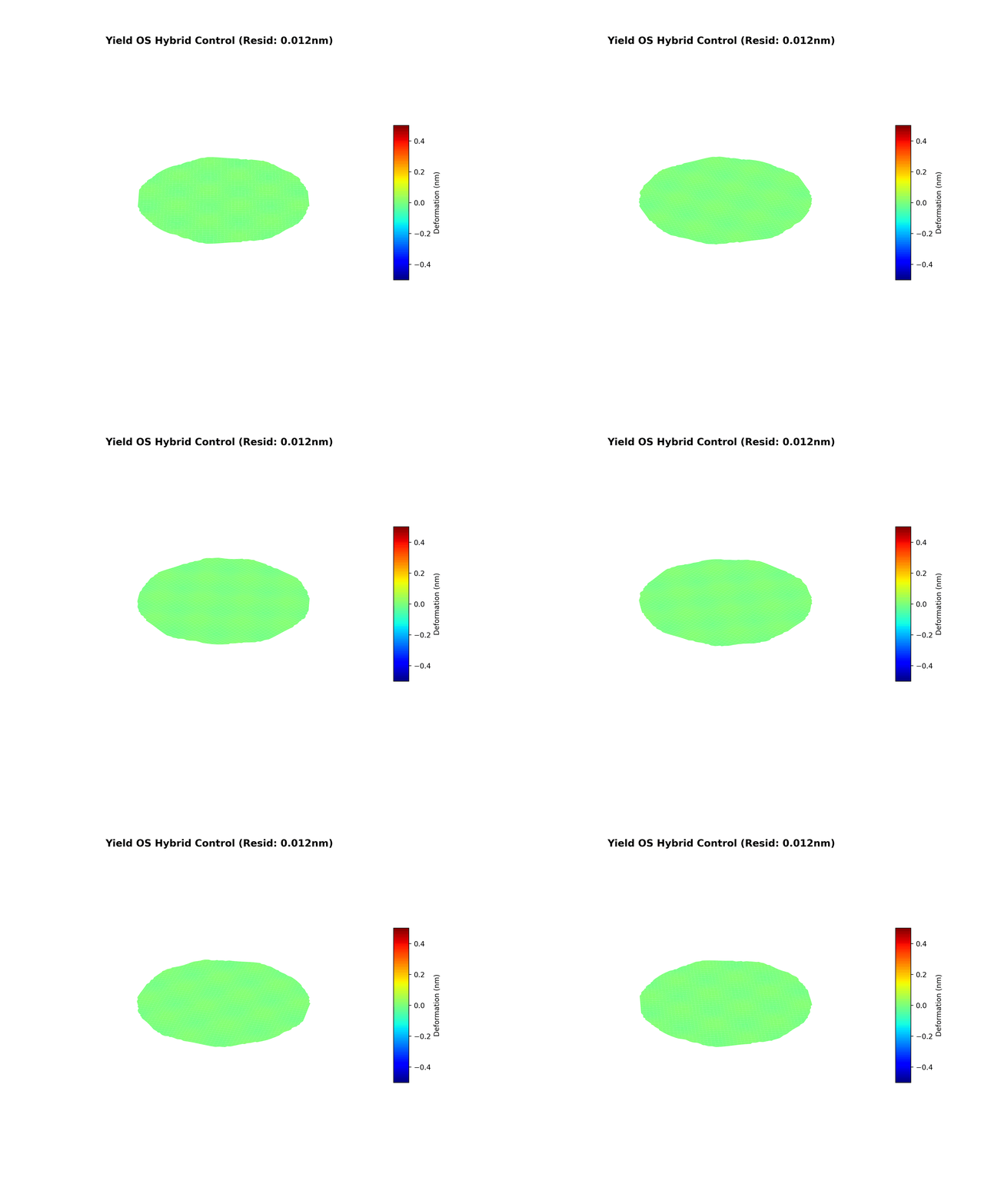
Generative Evolution: Noise → Optimal Design
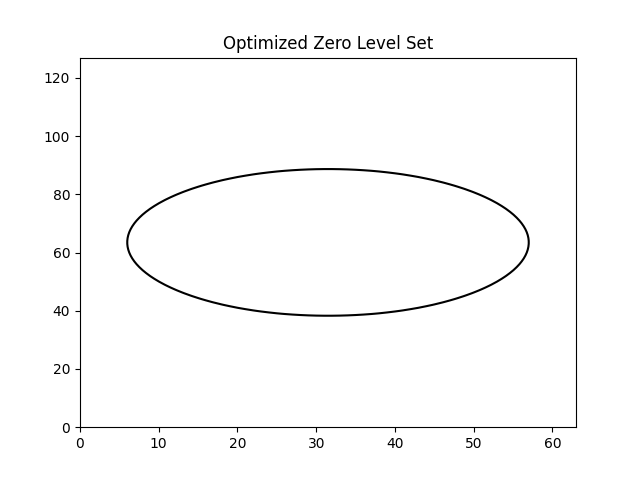
Validated CFD Result (Real Physics)
Cross-Domain Validation
The same Universal K Law produces validated results across thermal, structural, and fluid domains.
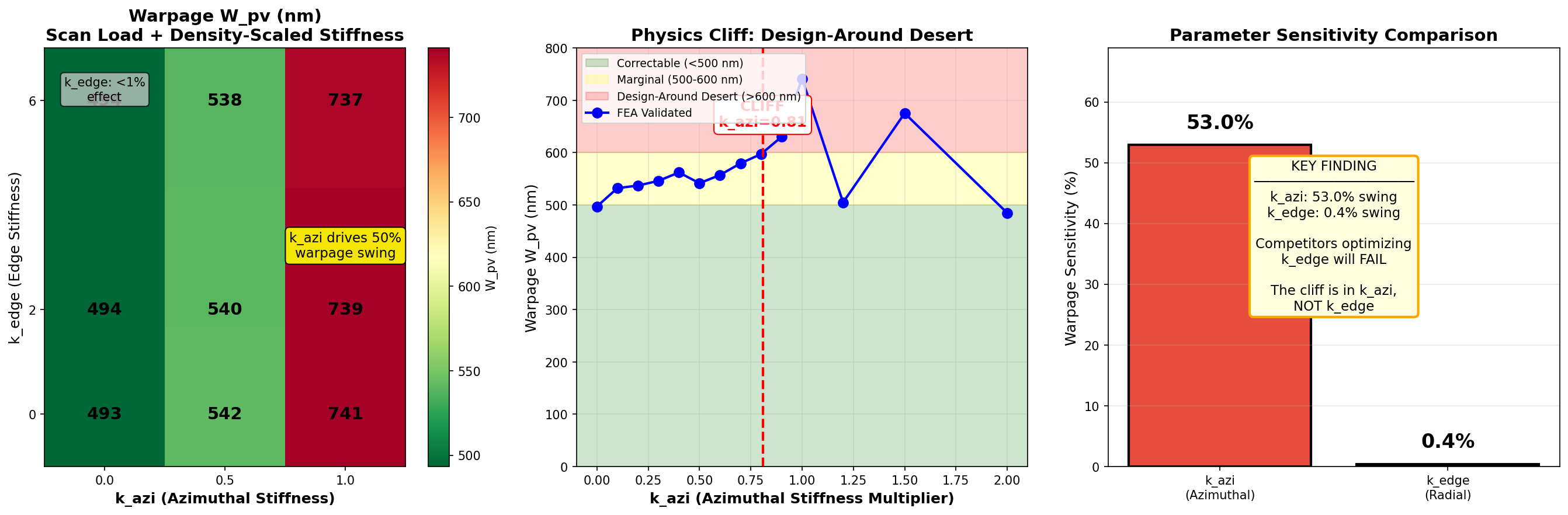
Phase Cliff Discovery
Neural Valve: AI-Generated Topology
Cross-Pollination: The Proof That It Works
A platform that claims to unify physics domains must prove it. Five cross-pollination inventions demonstrate that Genesis is not nine independent tools that happen to share a repository. Each invention combines solvers from two or more patent data rooms to produce something that neither room could produce alone. These are not toy demonstrations. Each invention is 500-750 lines of production code, targets a specific billion-dollar market, and produces simulation results that can be independently verified. Total cross-pollination codebase: 3,413+ lines.
The key insight is that cross-domain inventions emerge naturally when the coupling infrastructure is right. When a thermal solver can talk to an electromagnetic solver without manual file translation, an engineer will inevitably discover that the same Marangoni cooling fluid that manages chip junction temperatures can also cool 5G antenna arrays. When a solid-state battery solver can couple to a thermal solver, the self-cooling battery pack becomes an obvious next step. These are not incremental improvements. They are new categories of device that only exist because the platform makes cross-domain simulation effortless.
Self-Cooling 5G/6G Antennas
Combines Marangoni self-pumping thermal management (PROV 3) with electromagnetic isolation synthesis (PROV 8). The antenna array integrates microfluidic cooling channels that activate at thermal hotspots without pumps, while targeting 40-55 dB practical isolation between elements (TMM theoretical; practical isolation depends on fabrication). Thermal and EM fields are co-optimized so that the cooling channel geometry does not degrade RF performance.
Self-Cooling Battery Packs
Three-way coupling: solid-state battery electrochemistry (PROV 6) generates heat during fast charge, Marangoni thermal management (PROV 3) removes it without mechanical pumps, and the fabrication OS (PROV 1) ensures the battery-cooling integration survives manufacturing. Dendrite suppression and thermal runaway prevention in a single simulation.
Glass Chiplet Integration Platform
The Glass PDK (PROV 7) provides the substrate and waveguide design rules, the Isocompiler (PROV 8) synthesizes electromagnetic isolation structures between chiplets, and Bondability (PROV 9) predicts hybrid bonding yield from the composite design. End-to-end: glass substrate layout to predicted manufacturing yield. The platform that makes glass interposers 2-4x cheaper than CoWoS actually buildable.
Photonic Molecular Filter
Photonics (PROV 4) provides FDTD optical simulation of glass waveguide structures. Smart Matter (PROV 5) provides DFT-verified molecular binding models for PFAS and rare-earth selectivity. Combined: a photonic filter that uses light to selectively capture target molecules from mixed streams. Optical resonances are tuned to match molecular absorption spectra for maximum selectivity.
Adaptive Wafer Cooling for EUV
The most ambitious cross-pollination: four data rooms combined. Fab OS (PROV 1) predicts wafer warpage under EUV exposure. Packaging OS (PROV 2) provides the substrate mechanical model. Thermal Core (PROV 3) delivers adaptive Marangoni cooling. Solid State (PROV 6) handles the electrolyte thermal properties. The result is an EUV wafer chuck that dynamically adjusts its cooling response to the evolving thermal map during exposure.
vs. Traditional EDA: COMSOL, Ansys, Synopsys
The incumbent simulation ecosystem is a patchwork of specialized tools acquired through decades of mergers. COMSOL Multiphysics excels at coupled PDE solving but requires manual setup of each physics interface and does not ship domain-specific intelligence for semiconductor fabrication, battery chemistry, or photonic PDKs. Ansys offers powerful structural (Mechanical) and fluid (Fluent/CFX) solvers but charges per-module licensing and requires explicit coupling workflows between products that were originally developed by different companies. Synopsys provides semiconductor-specific tools (Sentaurus, TCAD) but does not extend into thermal management, battery physics, or materials discovery.
Genesis is architecturally different. All 104 solvers live in a single Python codebase, share common data structures, and communicate through the generic coupler without file-based intermediate formats. There is no module licensing. There is no export-import cycle. There is no manual mesh translation between tools. An engineer who needs to understand how EUV wafer warpage affects optical waveguide alignment in a glass interposer does not need to buy four separate products, learn four different GUIs, and write custom scripts to glue outputs together. That engineer writes one API call that chains the Fab OS FEM solver to the Glass PDK optical model to the Isocompiler EM analysis.
More fundamentally, Genesis embeds domain knowledge that general-purpose tools do not have. The platform knows that ASML EUV scanners communicate via SECS/GEM protocol. It knows that glass interposers need to satisfy specific DRC rules for hybrid bonding. It knows that Marangoni self-pumping requires a surface tension gradient above 5.0 mN/m. It knows that dendrite suppression in solid-state batteries requires gyroid lattice tortuosity above a critical threshold. This domain knowledge is encoded in the solvers themselves, not in user manuals that engineers must read and manually implement.
The fundamental difference is architectural, not incremental.
COMSOL and Ansys are collections of solvers that can be made to talk to each other with effort. Genesis is a single physics engine where coupling is the default state and isolation is the special case. This architectural choice is what makes the five cross-pollination inventions possible: they fell out naturally once the coupling infrastructure existed. No one at COMSOL or Ansys will accidentally discover a self-cooling battery pack, because their thermal and electrochemistry modules do not share memory.
The Universal K Law
Core Innovation — Patent Pending
The same mathematical principle governs optimal material distribution across structural mechanics, thermal management, and optical design. This unification enables cross-domain insights and dramatically accelerates design optimization.
Nine Patent Data Rooms
Each data room is a self-contained IP package with patent filings, validated solver code, reproducibility scripts, and machine-readable evidence artifacts. Together they cover the full stack of advanced hardware physics: from the EUV lithography step through packaging, thermal management, photonics, molecular engineering, battery electrochemistry, glass interposer design, electromagnetic isolation, and hybrid bonding yield. Having all nine under one roof means cross-domain queries that would require months of inter-vendor negotiation become single API calls.
Fab OS
112 claims. 90.3% warpage reduction. Biharmonic FEM wafer solver with iterative learning control. ASML SECS/GEM integration for real-time scanner feedback. 5,813 files including 864-case validation database.
Packaging OS
150 claims (26 independent, 124 dependent). 0.000% azimuthal effect (30 NLGEOM FEM cases). Kirchhoff-von Karman nonlinear plate solver for rectangular substrates. AI compiler ROM with R²=0.9977 (training; CV: R²=0.89±0.02). Proves Cartesian panel physics.
Thermal Core
~200 claims. 68.9C junction at 133 W/cm². Self-pumping Marangoni cooling with 1.6-2.4x flow-to-flow CHF enhancement. Zero-G stable at Bo < 0.1. Neural valve topology optimization. 2,183 files.
Photonics
Multi-patent portfolio. 40-55 dB practical RF isolation via TMM analysis. Superluminal Glass (n=1.15) engineered for low-index waveguiding. FDTD 2D/3D with PML boundaries. Zernike decomposition for aberration analysis.
Smart Matter
51 claims. 730 candidate scaffolds (20 DFT-verified) for molecular selectivity. Janus particles, PFAS capture, Steric Sieve architectures. Kremser cascade reactor simulation. Born-Rashin-Honig membrane pore modeling. 1,493 files.
Solid State
96 claims. Gyroid passes Monroe-Newman dendrite suppression to 60% porosity (1.8x threshold). Phase-field is qualitative only (Cahn-Hilliard correct model). Four-pillar architecture: Stiffness Trap, Steric Sieve, Internal Tensegrity, Smart Fuse (19 Pareto configs). 0.112 mS/cm conductivity. 2,489 files.
Glass PDK
8-patent portfolio. 2-4x cheaper than CoWoS silicon interposers. 605 analytically screened design points. YAML-to-GDS compiler with DRC, Pareto optimization, and EDA export (HFSS/Sigrity). Full-wave truth-set extraction.
Isocompiler
72 claims draft. 132 tests pass. 22-39 dB frequency-dependent EM isolation. Adjoint r=1.0, 27 dB topology optimization. FDTD electromagnetic coupling decomposition, Nevergrad optimization, KLayout DRC, Palace full-wave verification. 533 files.
Bondability
Research phase. Full GDS-to-yield pipeline: CMP topography prediction, spectral FFT contact mechanics, void formation, thermal stress FEA, delamination risk, Monte Carlo yield. 1,128 files with 17-file pytest suite.
Why Nine Rooms Under One API Matters Commercially
A semiconductor company evaluating advanced packaging cannot separate thermal management from structural integrity from electromagnetic isolation from bonding yield. These are not independent purchasing decisions; they are coupled physics problems. A customer who licenses PROV 7 (Glass PDK) will inevitably need PROV 8 (Isocompiler) for electromagnetic isolation, PROV 9 (Bondability) for yield prediction, and PROV 3 (Thermal Core) for thermal management of the completed package. The data rooms are commercially synergistic because the physics is coupled.
For enterprise IP buyers, the portfolio creates a defensive moat. Acquiring one data room gives you a point solution. Acquiring all nine gives you a platform that covers the entire physics stack from wafer to package to system. The cross-pollination inventions are proof that the value of the combined portfolio exceeds the sum of its parts: self-cooling batteries, photonic molecular filters, and adaptive wafer cooling are inventions that only exist because multiple data rooms are integrated.
Unified CLI and 87-Endpoint API
Enterprise integration requires more than good solvers. It requires a programmatic interface that fits into existing CI/CD pipelines, EDA tool chains, and data lake architectures. Genesis ships two complementary interfaces: a Typer-based CLI with 9+ subcommands for interactive use and scripting, and a FastAPI gateway with 11 routers serving 87 endpoints for REST integration.
The CLI provides direct access to every solver from the command line. An engineer can run genesis thermal simulate to execute a Marangoni boiling simulation, genesis solid-state dendrite to run dendrite suppression analysis, or genesis glass-pdk compile to compile a PDK from a YAML configuration. Each subcommand maps directly to a solver or pipeline, with consistent argument naming and JSON output for downstream processing.
The API gateway enables headless integration. Each of the 9 data rooms gets its own router with dedicated endpoints: /v1/fab-os/predict for FEM warpage prediction, /v1/thermal/simulate-gpu for GPU-preset thermal simulation, /v1/bondability/run-pipeline for full GDS-to-yield analysis. The platform router at /v1/platform/pipeline/lbm-fem exposes the coupled multi-physics pipelines directly. Lazy-loading ensures that starting the API server does not require loading all 9 data rooms into memory; routers load their solvers on first request.
TPMS, LBM, FEM, FDTD, MD, LBM-FEM pipeline
FEM warpage, ILC, cliff sweep, batch validation
Kirchhoff solver, ROM prediction, hexapole
Marangoni sim, GPU presets, stability envelope
TMM firewall, Zernike, neff, claim verification
ML screening, Kremser reactor, membrane, COGS
Gyroid lattice, dendrite sim, tortuosity, selectivity
YAML compile, Pareto optimize, EDA export
Coupling decomposition, synthesis, DRC
GDS-to-yield pipeline, CMP, optimize, benchmark
Latent Physics Model inference and metrics
Enterprise Deployment
The platform ships as a Docker container (3-stage build: Python 3.11-slim builder, production runtime, Node 20-slim website) with a health check on /health. Deploy behind your existing API gateway, connect to your CI/CD pipeline, feed results into your data lake. Swagger UI at /docs and ReDoc at /redoc provide interactive API documentation for every endpoint.
Cryptographic Provenance
Every simulation is cryptographically signed
Complete audit trail from input geometry to optimized output. Verifiable, reproducible, defensible. Every data room ships with validation scripts that regenerate results from source and verify SHA-256 hashes against stored evidence artifacts. This is not a feature added after the fact; provenance is built into the solver infrastructure itself, ensuring that every patent claim is backed by reproducible, tamper-evident computational evidence.
Key Results
Physics Solvers
104
Patent Data Rooms
9
Total Claims
900+
Total Files
19,400+
Design Desert
93% fail unguided
API Endpoints
77
Applications
Genesis Engine Technical Data Room
The unified physics simulation platform with 900+ patent claims across 9 data rooms. 104 validated solvers (LBM, FEM, FDTD, MD, TMM, phase-field, P2D), AI-driven design, and complete CLI/API documentation. Available under NDA.
Request AccessReady to solve this problem?
Schedule a technical discussion with our team.